venerdì 11 marzo 2022

 Ink drops number 2 and 3.


From the series “China’s drops”, oil and pencil on paper, 24 x 24 cm, 2002.

If you try to drip a drop of ink on a wet surface you can observe that it doesn’t spread evenly, diluting in water, but expands in a sudden and irregular way, causing streaks and branches that are oriented on the surface on the basis of the obstacles or impurities encountered, perhaps invisible. This generates a rich arabesque, a pure decoration that can vary from time to time, and that expands until it fills the entire surface.

martedì 22 febbraio 2022

Alphabet

SENTENCE NUMBER 16 and SENTENCE NUMBER 17. 
China ink on paper. 20 x 20 cm each one, 2001.


A barcode is the graphical representation of a series of numbers. What creates the aesthetics of a barcode? It comes from lines, their thickness, the spacing. We can think of it as a language with its composition rules, its grammar and its syntax. I imagined isolating these rules, separating them from the original purpose for which they were created, and I tried to change them gradually to invent a new language and perhaps new meanings. 

mercoledì 9 febbraio 2022

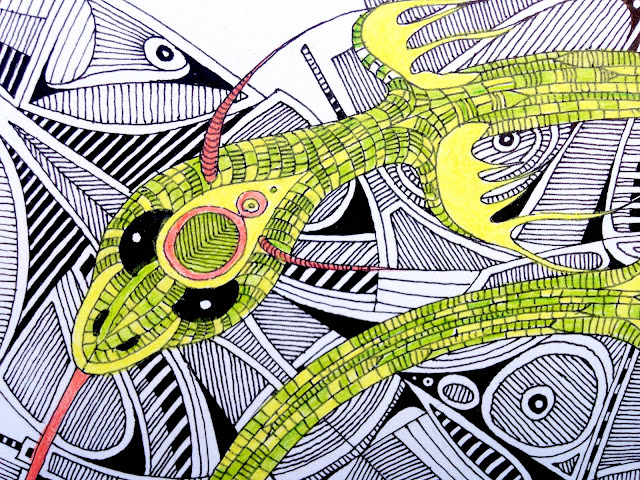
Spiral snake


An original piece from the series “Snowflakes”, ink and paint on paper, 30 x 30 cm. Original sold.

Someone teaches us that the snowflakes are different from each other since we are small children. We learn that they are formed with a crystallization process that follows a geometric pattern that changes each time, indefinitely, never having the possibility of a repetition. The ice crystal takes shape slowly, expanding from a central point to the surrounding space, obeying to some strict symmetrical scheme, until all unallocated space is filled with these icy branches. What happens if in this process, the atoms of the water, in the meanwhile they are solidifying, encounter an obstacle, a slag, an impurity? Will it also remain trapped inside the grid? Will it be absorbed by this geometric cage, or would be able to break the symmetry, imposing its diversity?


giovedì 27 gennaio 2022

Space dog


An original piece from the series “In the absence of God”, pencil on paper, 28 x 40 cm, 1999.

The medieval illustrators represented animals that they had never seen, described by others, or derived from mythology. This generated monstrous creatures. From here comes the idea of a common set of animals, which are deformed with the help of redundant decorative codes. 
These artworks are made on paper overlaying subsequent layers of oil painting and pencil drawing (I often use graphite not only to emphasize the traits but as a color itself, to fill and darken entire areas of the drawing).

martedì 11 gennaio 2022

Hands


HANDS. Pencil, ink and iodine tincture on thick paper, 22 x 22 cm, 2000.

venerdì 24 dicembre 2021

Turtle and lizard


An original piece from the series “Ancient beasts”, ink on paper, 30 x 21 cm, 1999.

The medieval illustrators represented animals that they had never seen, described by others, or derived from mythology. This generated monstrous creatures. From here comes the idea of a common set of animals, which are deformed with the help of redundant decorative codes. To simulate the ancient miniatures, I use ink and uniform color areas.

mercoledì 22 dicembre 2021

Imaginary portrait


IMAGINARY PORTRAIT.  Oil on canvas, 30 x 40 cm, 1997.

A series of very simple small works, almost trivial: each painting depicts a face and an expression.
Is it possible to create a catalog of all the expressions of the human face? Is it possible to classify all the attitudes that our face can take and give a name to each one? No, obviously, because the expressions are endless, as well as the possible variations in the human physiognomy, so that a certain attitude, worn by different faces, can assume from time to time different meanings. It's a game in which the variables are too many to govern, a sort of indeterminate equation. But then, what sense can have a job like that? Indeed, it could be interesting to investigate why, who portrays the faces, has chosen these, among all the possible infinite combinations. There are some recurring elements? The expressions are mostly happy, or sad and pensive? The eyes are directed towards the observer, or are they absent, facing something hidden? Eventually, this collection of chromosomes will not be able to describe a kind of genetic code, but it will be something very close to the genetic code of the artist.